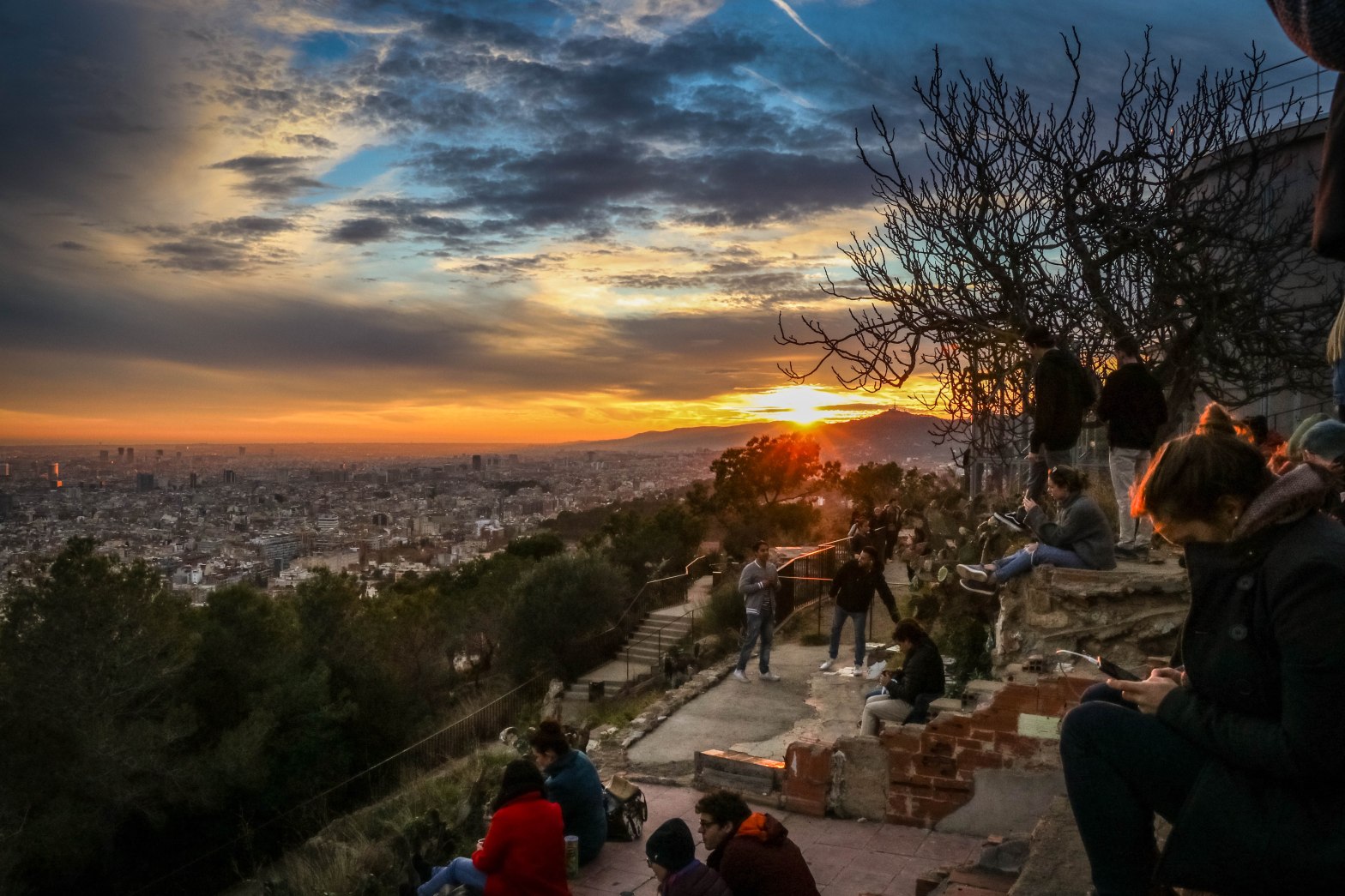
I am done reflecting on this event. Not much else to say. Life goes on and I’m fortunate for the experience traveling in Europe either way. Just a bit of a sour taste lingering…
Video: Aveiro, Portugal

Aveiro is known as the Venice of Portugal because of its many canals dissecting the city.
It was a great stop between Porto and Lisbon. I found the softest white sand beach I’ve ever seen, ate some great Portuguese food, and saw a gorgeous sunset and sunrise.
I jumped the gun making this video because I was so stoked about the drone footage. Seville, Madrid, Vigo and Porto are still in the works.
Video: Malaga and Ronda, Spain

I can’t imagine a better way to begin the Month of December than taking a spur-of-the-moment flight to Southern Spain. Sunshine and beautiful landscapes are unavoidable down here. I felt a warm welcome from the Spanish people and was thankful for the years of Spanish classes that I never thought I would use (shout out to Don Carlos).
After a quick and rainy stint in Malaga, I took a day trip to Ronda on my way to Seville. Ronda’s main attraction is a bridge built in 1793. It is amazing to imagine the construction of a bridge like this occurring more than 200 years ago.
As I was setting up my camera for a quick check in on the bridge, I asked a passerby what he could tell me about it. I share his response in the video.
Subscribe to my YouTube account and follow here on WordPress to get updates from me in the future
Behind a Sheet of Glass

Greetings! 2017 is culminating and so is my Europe trip. Feeling inspired and motivated to get some thoughts out there today, I have a little rant to share with you.
Maybe I’m wrong about all of this- but it’s just some food for thought following my previous post: “The Happiest People on Earth.” For the record, and to compliment a point I will touch on in the following paragraphs, I do not condone any sort of negative comments or demeaning opinions. I believe in respect for all human beings regardless of race, religion, gender, political affiliation, etc.
Just for a moment, contemplate what life was like hundreds or thousands of years ago. Were people generally happier than they are today, even without the comforts of modern society? I imagine that before the days of mass media, popular culture, and the internet, people shared deeper bonds. In a town of 150 people, if you have a problem with someone, you solve it. You don’t have the option to bicker over social media. Minor disagreements didn’t evolve into feuds over the internet. People didn’t compare their lives by examining others’ Facebook profiles. Families lived together; children cared for their parents as they aged instead of sending them to an old folks’ home. Smaller communities were more interdependent. Instead of going to a retail store (or Amazon.com) folks relied on each other for basic goods; food, clothing, tools- in a small town before the industrial revolution, life was more of a team effort.
When Henry Ford introduced the model-T to mass markets, folks waved the red flag on the phenomenon that we know as “road rage.” Without face-to-face communication, simple disagreements on the road have escalated into life or death situations.
A few months ago I was driving home on the highway late at night and noticed a car without lights on. Feeling obliged to help, I flickered my headlights in their rear-view mirror. No response. So I did it again. After two unsuccessful attempts I pulled up next to the car and began signaling with my hands to the driver of the other car. The driver reacted harshly, putting up her middle finger and staring straight forward. I just wanted to help keep her safe, so I stayed put, calmly waiting for her to look over. After what seemed like minutes, she finally glanced my way and noticed my “turn on your lights” hand signal. Immediately, she put down her middle finger and began blowing kisses, signaling regret and apology. It was a funny incident because she was clearly a good person, but something about being behind a glass window primed her for conflict.
Along the same lines, another time I was heading down with a group of friends to go skiing. It was a cold, rainy Winter morning. Around 7:30 a.m. cruising in the outskirts of Enumclaw I noticed a cop hidden on the side of the road. Again, in the interest of my fellow Washingtonians, I began flicking my headlights at oncoming traffic. Suddenly the car in front of me slammed its breaks. The driver, a middle aged balding man opened his door and charged us, a wild-eyed look of aggression in his eyes. I swerved around him and he began chasing us.
I could recall another half dozen or more instances similar to the two I just mentioned. I’ll be the first to admit I am not the most passive driver on the road, but the point is, without face-to-face contact, good intentions can be perceived negatively. It’s the same, if not more so, with modern communication technologies like Facebook and social media, text-messaging, the internet, etc.
Think about a time when you sent a text or made a comment about something publicly that wasn’t received accurately. It happens all the time, and as you get older, the stakes get higher. Take the “Google Memo” for example. Citing scientific studies and facts, James Damore, a Google engineer, shared a memo (deemed ‘anti-diversity’ by mainstream news outlets) that ended up costing him his job and made him the face of sexism in the technology sector. I’d recommend reading his memo and deciding for yourself if he was being overly discriminatory towards women or if he had good intentions which were received poorly. Ultimately it doesn’t matter what he wrote now that journalists and the internet have deemed the memo “sexist”, publishing his comments but omitting the references! Touting headlines that grab readers’ attention, journalists misrepresented his message and used the story as a means to generate views. When I Googled, “The Google Memo Guy” these are a few of the headlines which are displayed first:
Fired Google Memo Guy Also Has Bad Opinions About the KKK
“The Google memo guy just showed everyone why he got fired”
The Guy Who Wrote The Google Anti-Diversity Memo Did A Twitter Poll On “Cool” KKK Titles
The fact that several of the top links on Google make reference to this “KKK Twitter Poll” is disturbing, as it avoids any real conversation on the topic James felt compelled to address. Rather than analyze James’ memo and respond in a scientific manner, writers choose catchy headlines which lead into discussions about a tangential issue. Here is the Tweet, without going too in depth, to give some context:

Check out the buzzfeed article that attempts to shame James’ twitter behavior. Say what you want about his judgement on Twitter, James isn’t perpetuating any sort of negative opinion.
This event became such a big deal that I would venture to guess many of you reading this have already formulated opinions about James and his memo. If you want to hear him speak to the situation you can find an interview with Joe Rogan here: Joe Rogan Experience #1009 – James Damore. One thing about Rogan’s podcast I respect is his willingness to hear out differing opinions even when he knows it might cast him in a bad light. I would like to adopt a similar mindset in my career. As a Journalist, there is no value in towing the mainstream line. There are already enough people following the herd.
Despite mainstream outlets and the top Google results deeming James guilty with poor character, looking at the YouTube comments offers a different perspective. Take a look at the top comments below the video- many of them sympathize with Damore and contradict the mainstream rhetoric; of course, YouTube comments are not particularly eloquent, but they offer an alternative perspective on how people feel about an issue.
This example illustrates how sharing genuine ideas backed up with data and statistics can result in a career-ending witch-hunt if they run counter to the politically-correct nature of today’s society. Even though I won’t have more than a few dozen readers of this blog, it still causes me some anxiety to imagine folks who are loyal to mainstream rhetoric fuming about my sympathy for James’ situation.
Of course, making racism, sexism, and bigotry intolerable is a positive development for society. However, it frightens me to think that free speech and genuine beliefs are also less tolerated. The key to this problem is to accept every opinion, no matter how absurd you perceive it to be, without jumping to conclusions about each other’s character. Put yourself in the shoes of a Neo-Nazi. Then imagine what it would be like to be a feminist. If you can’t sympathize with both ends of the political and social spectrum then there is no reason for you to judge others’ opinions.
Would this level of tension in society be possible without the advent of modern technology? If folks sat face to face would disputes escalate like Twitter arguments and Facebook rants? What happened to the Socratic method? Where is Social Media 101 in public education?
Although the current social atmosphere is complex and cannot be broken down in one single blog, I’m content with this discussion as a jumping off point for future thought development. I hope there are some smart, wise people writing books and making videos to help the rest of us come together in the future.
Video Update 13: Copenhagen v2

One month to go in Europe! Despite taking a tough loss in Northern Sweden after leaving a bag of items in a car we hitch-hiked in, the trip goes on!
The “Happiest” People on Earth

According to the World Happiness Report, Danes are the happiest people on Earth. During my time in Denmark, this statistic was touted commonly; I found the topic interesting because it prods at our fundamental beliefs and core values. It also takes after the state of the economy, the government, and how the country’s structure coalesces. Indeed, I met people who were overtly happy and extremely generous. Staying with my friend Derek and his host family, I was welcomed with open arms and genuine hospitality. But walking the streets, riding the buses, and interacting with locals, I didn’t notice people were significantly happier.
To pass time on the train I decided to investigate the World Happiness Report (WHR) for myself, to study how the data was collected, and how valid its claims really are. I began, intending to rip it apart and find as many flaws and errors as possible. I expected an easy read that would trigger a rant about how externalities (for example: social programs, income level, and material wealth) don’t produce happiness. However, after the first few pages I began finding valuable insights. The research does have major issues such as the limited number of responses (~1,100) and the challenges of ascribing concrete metrics to “happiness”. Like any anthropological study, there are reasons to question the results- most of which are admitted in the report. Ultimately, the discussion is more complex than simply denouncing the research effort altogether.
How was the research conducted?
I won’t bore you with the details- if you are interested I suggest looking at the report directly: World Happiness Report
Basically, there were two sets of data. The first, between 2005-11 and the second, from 2012-15. Using a scale of 1-10 (the Cantril Ladder) respondents from 156 countries were asked to rate their life satisfaction. Combining data from different regions and time frames provides two alternative analyses.
What stood out to me?
First, the report establishes the general result that income has more impact on life evaluations than emotions. This makes logical sense; when asked to evaluate your life objectively, income is inescapable. However, on an emotional level, income isn’t the only dog in town.
Secondly, the evidence suggests that “experienced well-being and a sense of life purpose are both important influences on life evaluations, above and beyond the critical role of life circumstances.” This implication is powerful because it goes to show that bad life circumstances can be overridden by a sense of purpose. See the evidence, and especially the role of positive emotions, in the figure 2.1 below.

Third, the “weekend effect (the phenomenon where the day of the week impacts the results) disappears for those employed in a high trust workplace, who regard their superior more as a partner than a boss, and maintain their social life during weekdays.” Big shout out to the managers (and future managers) out there: giving subordinates a sense of partnership and stake in business outcomes may support employees’ job satisfaction and overall happiness.
“Illustrative not conclusive” (a better way to say, “Fundamentally flawed”)
There are no metrics to evaluate happiness. Instead, the report chooses to focus on “subjective well-being.” According to the report, the 6 factors which account for about 74% of the correlation data are: GDP per capita, social support, healthy life expectancy, social freedom, generosity and absence of corruption.
“Much more research is needed to fully understand the interplay of factors that determine the inequality of well-being, but there is every hope that simply changing the focus from income inequality to well-being inequality will speed the arrival of a time when the distribution of well-being can be improved, for the benefit of current and future generations in all countries.”
The final statement reads:
This conclusion drives home a great point which has been missed in years past. Rather than focusing on wealth and material resource distribution, governments and organizations should focus their efforts on the immaterial factors which sustain a quality social fabric. To support this assertion, the report looked at the change in life evaluations between 2005-07 and 2011-13. What they found was that although many of the countries which experienced economic declines did see their well-being degrade, economic factors were not the only influencer. In Greece, specifically, the report suggests a weak social fabric and ongoing political issues may have accounted for some of the decline.
My biggest complaint about perpetuating this sort of research is that most people just catch the headline. Articles written on the topic tend to focus on one attention grabbing hook in order to generate interest; for example, the top 5 “happiest” countries or the single most important factor influencing life satisfaction. While accurate, it’s important to understand the whole compilation of research.
The Distributions based on region:

Trip Update 12: Nice

After a brief stop in Rome, the adventures continued in Nice, France. By the way, I only pronounced the name, ‘Nice’ incorrectly because a German dude told me it was pronounced “Neitzche” instead of “niece”.
The water was warm for mid November and the weather was superb.
Next stop is Paris and Calais, but I don’t think I’ll make an update as I didn’t film much while meeting with Utopia 56, a non-profit organization working with refugees.
Shaking Things Up: Malaga, Spain

After losing my bag in Kiruna, Sweden, I found myself back in Copenhagen. I slept well for a few nights, worked out, and rode bicycles around the city. Rested up and ready to get back on the road, I knew I had to shake things up a bit. I don’t know what it is about pushing limits but something inherent draws me in. The idea of doing something “a little whacky” seems to lure me into sporadic, impulsive, spur-of-the-moment decisions. It’s the same reason why I prefer hiking through the night to catch the sunrise in the alpine rather than roll out of bed at a reasonable hour like everyone else. When I set my mind on a more “twisted” plan, it’s like a jolt of energy; I’ve developed an addiction to the natural caffeine-like feeling that accompanies executing a plan most people would consider absurd.
So, last night at about 1 a.m., I was perusing Google flights and Rome2rio.com trying to plan my next two weeks, including the remaining days on my Eurail Pass. I had been somewhat paralyzed by the overwhelming number of options and directions I could go. Switzerland? Back to France and Calais? Another tour of Eastern Europe, Prague, Salzburg, and Croatia? In the end, warm weather and spectacular outdoor beauty was too much to turn down. So I booked tickets for a 7 am flight to Malaga, Spain.

I departed my friend Derek’s place at 4:15 AM. Walk, bus, train, flight, train, walk. Simple as that. The new digs: a Hostel in the heart of Malaga, Spain.
My six years of skirting by in Spanish class are finally paying off. Although I butcher most of what I say, the fact that I am somewhat able to comprehend the language is extremely refreshing. People’s reactions are more positive and warm after a solid attempt, even if it’s wrong, than just strolling in, blurting out a bunch of English, and expecting the other person to understand. I can see why places like Paris would be awesome if you spoke French…
My plan is to get out of Malaga tomorrow morning, spend a night in Seville, then train north to Madrid Friday. I’m itching to get to the mountains but I have only 4 days left on the Eurail pass, so I can wait. I am unsure whether I’ll head to Portugal or spend the next 2 weeks in Spain. Planning day by day, truly living in the moment is the best feeling in the world.

Video: Visiting the Acropolis
October 21st in Athens, Greece was a beautiful day.
 Kyle Huber